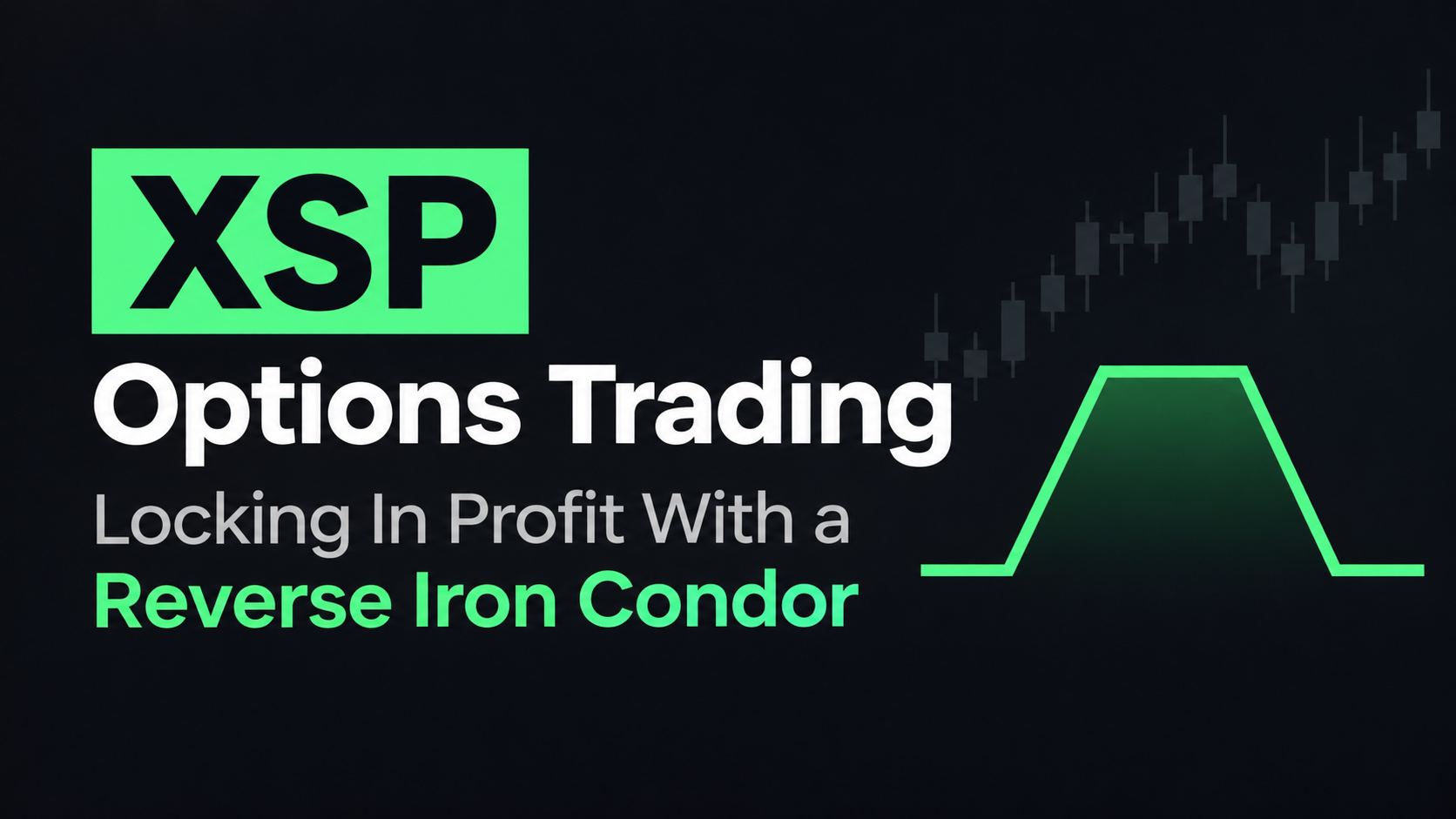
XSP Options Trading: Locking In Profit With a Reverse Iron Condor
One of the things I enjoy about trading index options is finding unconventional ways to manage risk. Sometimes that means looking beyond the traditional ways we're taught to trade credit spreads and iron condors.
In the video above, I walk through a real XSP 0DTE options trade that started as a bearish call credit spread and eventually became a reverse iron condor.
The interesting part? After the market moved in my favor, I was able to lock in a minimum profit of $36 while keeping the possibility of earning as much as $136 on a single spread lot.
And I didn't need to sit in front of the screen watching every market move for the rest of the day.
Let's look at how the trade worked and why XSP options are particularly interesting for this type of strategy.
What Are XSP Options?
XSP, also known as Mini-SPX, is an index options product that tracks the S&P 500 at approximately one-tenth the size of SPX.
For example, if SPX is trading around 7,700, XSP would be trading around 770.
That smaller contract size is one of the main reasons I've been exploring XSP for different options strategies.
XSP shares several important features with SPX options:
- Cash settlement: No delivery of shares when options expire in the money.
- European-style exercise: No early assignment risk.
- Smaller contract size: Approximately one-tenth the notional exposure of SPX.
- Daily expirations: Opportunities to explore 0DTE and other short-duration strategies.
- Defined-risk spreads: Traders can structure positions with predetermined maximum losses.
For retail traders who enjoy SPX options but want to experiment with wider spreads without committing as much capital, XSP can be an interesting alternative.
Of course, smaller contracts don't automatically mean less risk. The width of the spread, the credit received, and the number of contracts all matter.
Starting With an In-the-Money XSP Call Credit Spread
The trade in the video began with a fairly simple bearish outlook.
The market had gapped lower, rallied off the open, and I was looking for a potential move back down.
Rather than selling a traditional out-of-the-money call credit spread, I started with a deep in-the-money call credit spread.
Here's how the original trade was structured:
- Underlying: XSP
- Expiration: 0DTE
- Entry time: 9:35 AM ET
- Short call: 766
- Long call: 772
- Spread width: $6.00
- Credit received: $3.54 ($354)
- Maximum initial loss: $246
Why sell a spread so far in the money?
Because the objective wasn't necessarily to hold the spread until expiration and collect the entire credit.
Instead, I wanted the market to move a few points in my favor so I could potentially sell another spread and offset the original risk.
With a six-point-wide spread and a $354 credit, the maximum loss was $246 before fees.
That $246 figure became important because it represented the amount I needed to offset with the second trade.
Converting the Credit Spread Into a Locked-In Profit
After entering the position, XSP moved lower as anticipated.
Within roughly 15–20 minutes, the original call credit spread had an unrealized profit of approximately $60.
I could have simply closed the position, taken the profit, and moved on.
But I wanted to explore something different.
Could I use that favorable price movement to establish another spread, eliminate the original expiration risk, and still leave some additional upside?
The idea was to sell another spread that would generate enough credit to cover the original maximum loss.
Initially, I considered creating a more traditional iron condor structure, but the market hadn't moved far enough to provide the credit I wanted.
Instead, I was able to construct a reverse iron condor.
The resulting position had a modeled minimum expiration profit of $36 and a maximum expiration profit of $136, based on the fills shown in the video.
That's an important distinction: the original trade had risk. The locked-in profit only became possible after the market moved favorably and the second spread was executed.
These figures are before commissions, fees, and any execution-related costs.
Iron Condor vs. Reverse Iron Condor
Most options traders are familiar with the traditional iron condor.
A regular iron condor generally involves selling an out-of-the-money put credit spread and an out-of-the-money call credit spread.
The goal is for the underlying index to remain between the short strikes.
A reverse iron condor flips that structure.
Instead of having the short strikes on the inside, the long strikes are on the inside and the short strikes are on the outside.
In the video, however, I'm not opening a conventional reverse iron condor as a single debit transaction.
I'm legging into the position, beginning with one spread and adding another after the market moves.
That difference matters because the combined credits from the two transactions can create a very different risk profile from opening the complete strategy all at once.
Why Use XSP Instead of SPX?
One of the biggest advantages of XSP for this particular approach is position sizing.
With XSP trading at approximately one-tenth the size of SPX, I can experiment with relatively wide spreads while keeping the dollar risk more manageable.
For example, the six-point-wide XSP spread used in the video is roughly equivalent to a 60-point-wide SPX spread.
The original XSP trade involved $246 in maximum risk.
An equivalent SPX position would involve approximately $2,460 in risk.
That's a meaningful difference when you're testing an idea that may or may not work consistently.
And with XSP, the smaller contract size makes it possible to experiment with different strike combinations without necessarily taking on thousands of dollars in risk for a single spread.
There is a tradeoff, though. XSP can have wider bid-ask spreads and less liquidity than SPX or SPY, depending on the strikes and expiration. Execution quality is especially important when you're relying on multiple trades to create a favorable payoff.
Why Cash Settlement Matters
Another reason I like using XSP for these strategies is that it's a cash-settled index.
Just like SPX, XSP options are European-style and don't have early assignment.
That means I don't need to worry about being assigned shares of an ETF when an option expires in the money.
This becomes particularly useful with unconventional spread structures where some options may intentionally finish in the money.
The final settlement is handled in cash based on the index settlement value.
That doesn't eliminate market risk, but it does remove some of the share-delivery complications that can come with trading physically settled ETF options such as SPY.
For 0DTE traders, it's one more reason to consider XSP as an alternative.
Is This Really a Risk-Free Options Strategy?
This is probably the most important part of the discussion.
There is no risk-free entry into this strategy.
The original call credit spread had $246 in maximum risk, and the market could easily have moved against me before I had an opportunity to adjust the position.
In fact, I've had trades where the market didn't cooperate and I ended up closing the original spread for a loss.
The goal is to take advantage of favorable price movement to create a position with a positive minimum expiration payoff.
Once that position is established at the necessary prices, the combined payoff can be positive across the expiration price range.
But that's not the same as saying the entire trading process is risk-free.
You still have to consider entry risk, execution, slippage, transaction costs, and whether the second spread can actually be filled at the required price.
There's no free lunch in options trading.
Can This Approach Be Used With Other XSP Options Strategies?
That's something I'm continuing to explore.
The broader concept is to begin with a directional options position and use a favorable market move to create a second position that offsets the original risk.
There may be opportunities to do this with different combinations of call credit spreads, put credit spreads, iron condors, and reverse iron condors.
Some of the variables worth researching include:
- How far in the money to sell the initial spread
- The optimal spread width
- How much favorable movement is needed before adding the second spread
- Whether traditional or reverse iron condors offer better opportunities
- Time of day and market volatility
- How frequently the initial position must be closed for a loss
That last point is particularly important.
It's easy to focus on the trades where everything works and a minimum profit gets locked in. But to evaluate whether the overall strategy has a positive expectancy, we also need to account for the trades that never reach that stage.
That's where collecting data and backtesting become valuable.
Final Thoughts on XSP 0DTE Trading
What I find interesting about this XSP trade isn't necessarily the $36 minimum profit or even the potential $136 maximum gain.
It's the idea that we can take a relatively simple directional credit spread and turn it into a completely different position after the market moves in our favor.
And by using XSP instead of SPX, we can explore these wider spread structures with smaller dollar exposure.
I'm still experimenting with this approach, particularly the reverse iron condor variation, and I'm interested in seeing whether it can become a more repeatable trading strategy.
As always, the goal is to find opportunities where the historical data and risk/reward make sense, rather than assuming a single successful trade proves anything.
If you're interested in more research on SPX and XSP options trading, 0DTE strategies, and mechanical trading systems, visit Alpha Crunching, where I share backtests, trading tools, and ongoing research with our community.
Options trading involves risk. Examples are for educational purposes only. Past performance does not guarantee future results.