

SPX 0DTE Options Trading Research: Using Intraday Trend to Improve Credit Spread Timing
Introduction: The Real Problem With SPX 0DTE Credit Spreads
When trading SPX 0DTE credit spreads, direction matters more than most traders want to admit.
Even if your strike selection is solid, a strong intraday move against your position can quickly turn a high-probability trade into a stressful one. That’s true not only for SPX, but for credit spreads in general.
The challenge isn’t just what to trade—it’s when to trade.
This is exactly the problem we set out to solve with the Trend Spread Engine, powered by AlphaCrunching.com.
Why Timing Matters in SPX Options Trading
Most traders already understand concepts like:
- Gamma exposure levels
- Support and resistance
- Volatility regimes
The issue is that many of these approaches still require constant screen-watching and discretionary decision-making throughout the day.
That leads to:
- Overtrading
- Emotional entries
- Fatigue from watching SPX all session
Our goal was to make SPX 0DTE trend trading more mechanical, more repeatable, and easier to execute consistently.
The Core Question We’re Trying to Answer
If we use intraday trend as part of our process, is there a specific time of day that consistently works better for SPX 0DTE credit spreads?
If we can identify better time windows, we can:
- Reduce screen time
- Trade more systematically
- Rely less on news and emotions
- Focus only on high-quality opportunities
What Is the SPX Trend Spread Engine?
The Trend Spread Engine (TSE) is a rules-based system that posts SPX 0DTE credit spread alerts every 15 minutes, starting at 10:00 AM ET through 3:00 PM ET.
That creates:
- 21 potential trade intervals per day
- A structured dataset for analysis
- A foundation for real options trading research
Important note:
👉 This system is not designed for taking every signal. It’s designed for data collection first, execution second.
How the Trend Spread Engine Works
Step 1: Identify Intraday Trend
At each 15-minute interval, the system determines whether SPX is trending up or down.
Step 2: Match the Spread to the Trend
- Trend up → Put credit spreads
- Trend down → Call credit spreads
Step 3: Post Two Strike Variations
Each alert includes two defined structures:
- 5-wide spread
- Minimum Delta ~20
- 10-wide spread
- Minimum Delta ~15
This allows us to compare:
- Distance from price
- Risk-reward differences
- Win rate by structure
Why We Break the Day Into 15-Minute Intervals
We use a concept we call the Optimal Trend Interval.
Instead of asking:
“Is trend trading effective?”
We ask:
“At what specific time of day does trend + strike selection show the most consistency?”
Each 15-minute window is tracked independently, including:
- Spread type (call or put)
- Width (5-wide vs 10-wide)
- Outcome (expired worthless or not)
This lets us analyze SPX options trading behavior by time of day, not just by strategy.
Data Collection Comes First (Execution Comes Later)
Every Trend Spread Engine alert is logged into our database and evaluated with one simple initial question:
Did the spread expire worthless or not?
That’s it.
At this stage:
- No profit targets
- No stops
- No discretionary exits
We’re intentionally starting with raw outcomes to isolate where edge may exist.
Early Results: SPX 0DTE Time Windows Are Not Random
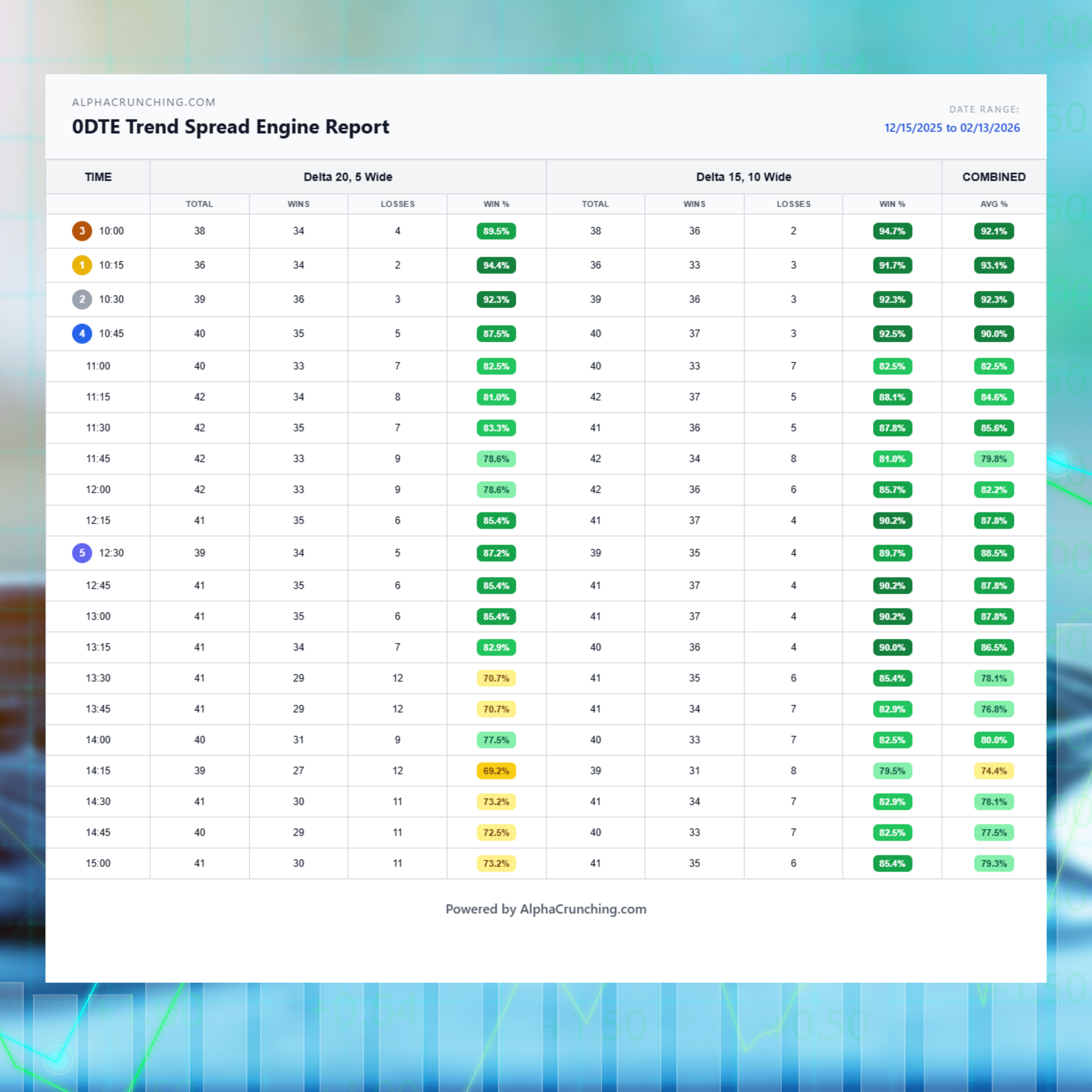
Even with only about one month of data, certain time intervals are already starting to stand out.
One example:
- 10:45 AM ET
- Currently showing a 100% win rate on the 10-wide spreads over ~18 trading days
Important caveat:
- A 100% win rate will not last forever
- Sample size is still small
- Risk management still matters
But the key takeaway is this:
👉 Some time windows appear less random than others when trend is involved.
Comparing 5-Wide vs 10-Wide SPX Credit Spreads
As expected:
- 5-wide spreads, being closer to the money, show more volatility in win rate
- 10-wide spreads tend to absorb price movement better when held to expiration
At the 10:45 interval:
- The 10-wide structure remained undefeated
- The 5-wide structure experienced a loss
This is exactly why we track both.
Where Risk Management Fits In
Once we identify time windows with strong expiration performance, we can ask a better question:
“Can we improve results further with basic trade management?”
For example:
- Adding a 50% profit target
- Avoiding late-day gamma risk
- Standardizing exits
In early testing, adding simple risk management to high-performing intervals improved consistency even further.
This is the phase we’re actively working through now.
Why This Matters for SPX Trend Trading
This approach shifts SPX 0DTE trading from:
- Constant monitoring
to - Targeted execution
Instead of trading all day, the goal becomes:
- Identify 1–2 high-probability time windows
- Combine trend + strike selection
- Execute with discipline
That’s a much more sustainable way to trade.
Join the Research at Alpha Crunching
The Trend Spread Engine is available to Alpha Crunching subscribers and runs daily inside our private Discord.
If you want to:
- Follow the live SPX 0DTE alerts
- See how the data is evolving
- Help shape the next phase of this research
👉 Join AlphaCrunching.com/pricing today.
Use code SPX50 to get 50% off your first month or year.
The annual plan works out to roughly 7 months free in your first year.
This is long-term options trading research, not hype—and we’re building it in real time.
See you in the next update.


.avif)
